

The complete guide
How to Choose a Garage Door Screen for a Double Garage
The problem with a garage you cannot open
Most double garages are wasted space for about half the year. In summer the room bakes, so you lift the door for air, and within ten minutes you are sharing the space with flies, mosquitoes, moths and the occasional wasp. In the evening it is worse, because the light inside pulls insects in from the whole street. So the door goes back down, the heat builds up again, and the garage goes back to being a place you walk through rather than a place you spend time in.
That is a shame, because a double garage is often the biggest flexible room in a house. It is already weatherproof and already big enough for a workbench, a car you are actually working on, a weights rack, a kid's craft table or a band's worth of gear. The only thing standing between you and using it is the choice between fresh air and insects.
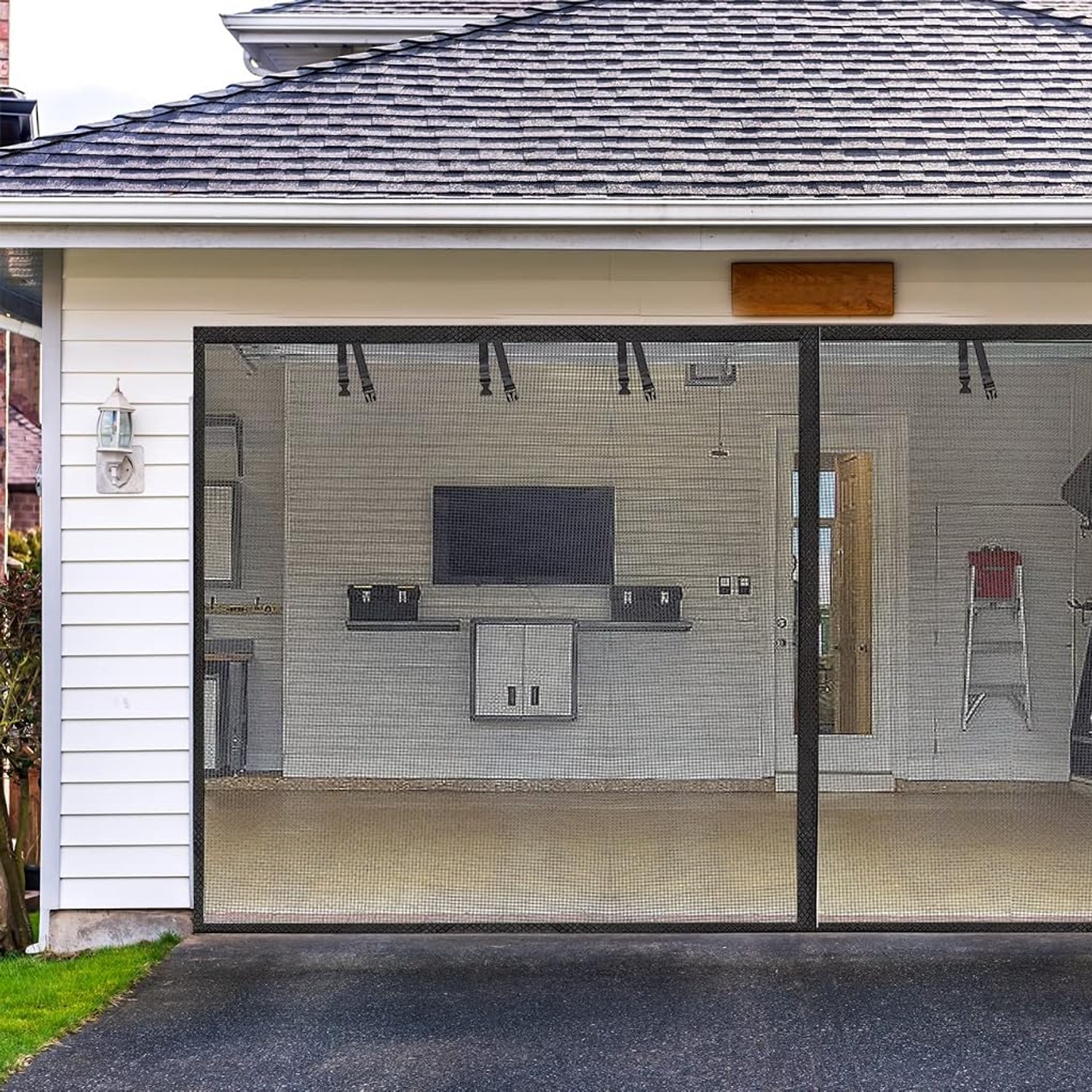
A garage screen door removes that choice. You hang a mesh panel across the open doorway, the air keeps moving, and the bugs stay in the driveway.
How a magnetic garage screen works
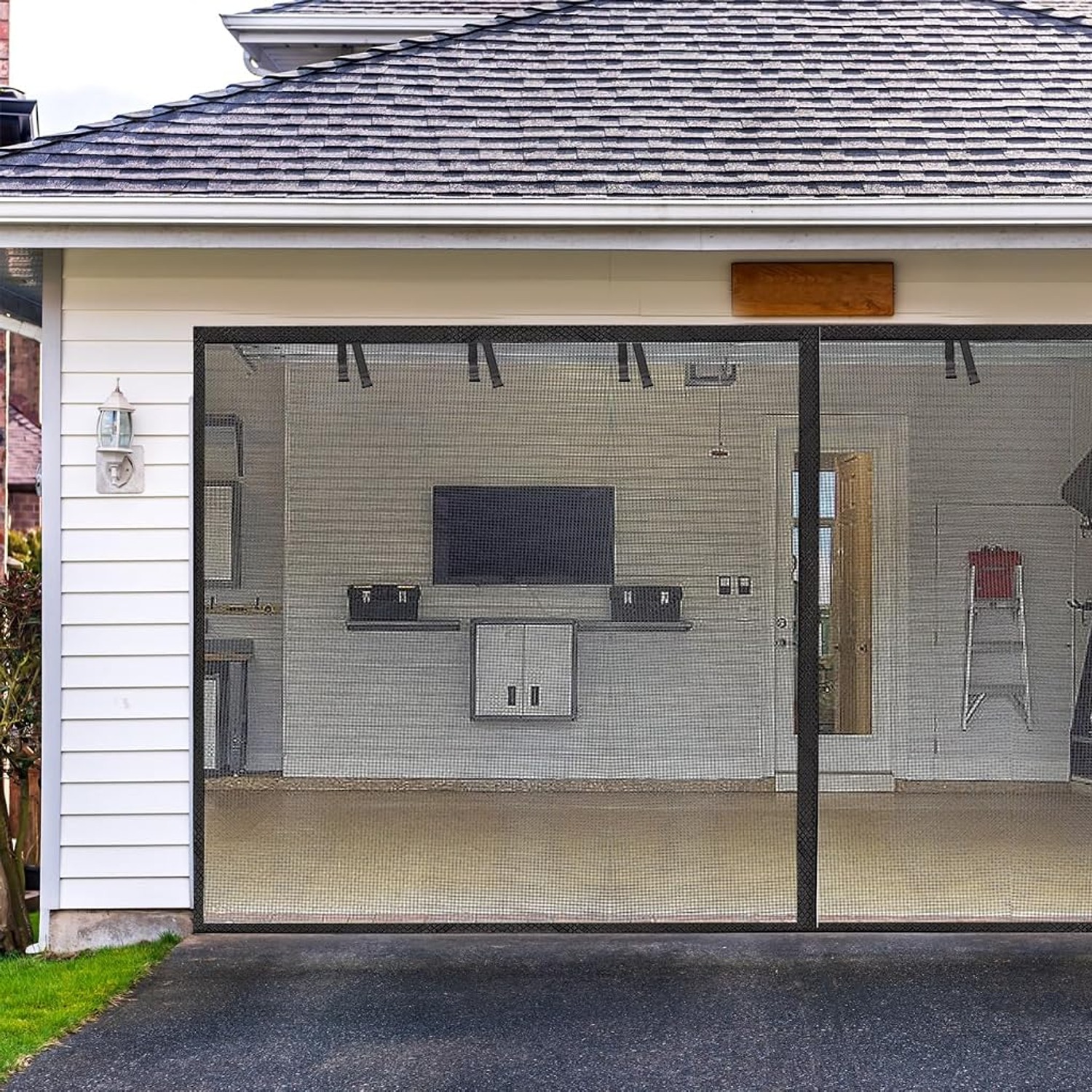
The idea is simple enough. A large mesh panel hangs across the full opening and is split down the middle. You walk at the split, it parts around you, and it closes again behind you.
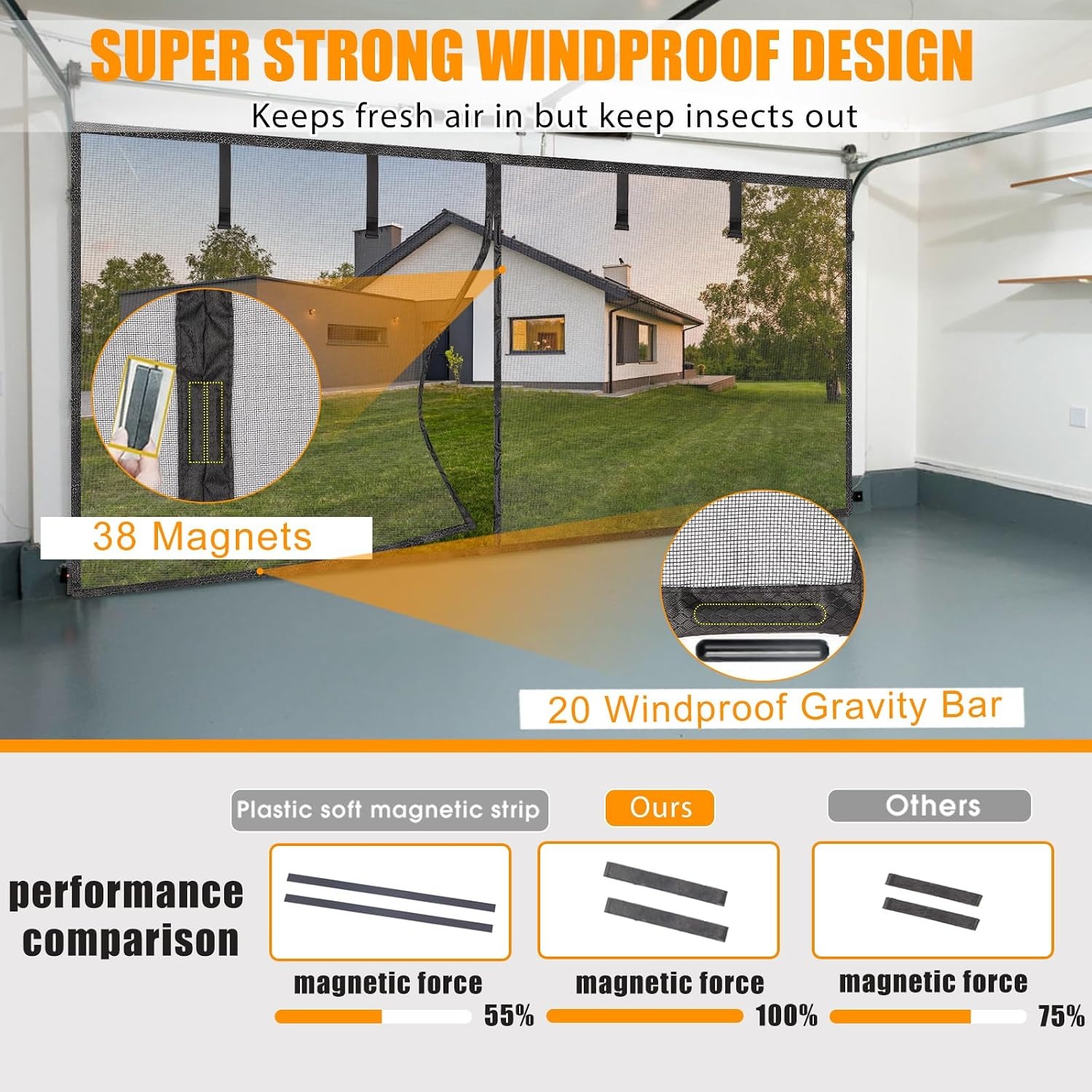
What makes or breaks the design is what happens at that split. On this screen, 36 magnets run down the center seam. They are strong enough to pull the two halves back together on their own, but light enough that a child or a dog can push through without a shove. That is the whole appeal of a hands-free screen door. You can carry a toolbox, a laundry basket or a barbell plate through it and never touch the mesh with your hands.
The second half of the design is weight. A big panel with nothing holding the bottom will lift in the lightest breeze and the seam will gape. Twenty weighted gravity sticks are sewn along the bottom hem to stop that. They keep the hem on the floor, keep the halves aligned and help the seam find itself when the panels swing back.
At the top, the panel attaches with hook-and-loop tape. One half of the tape sticks to the frame, the mesh presses onto it, and the top strip has been widened to 4 cm so it can carry the load of a 2300 g panel without peeling.
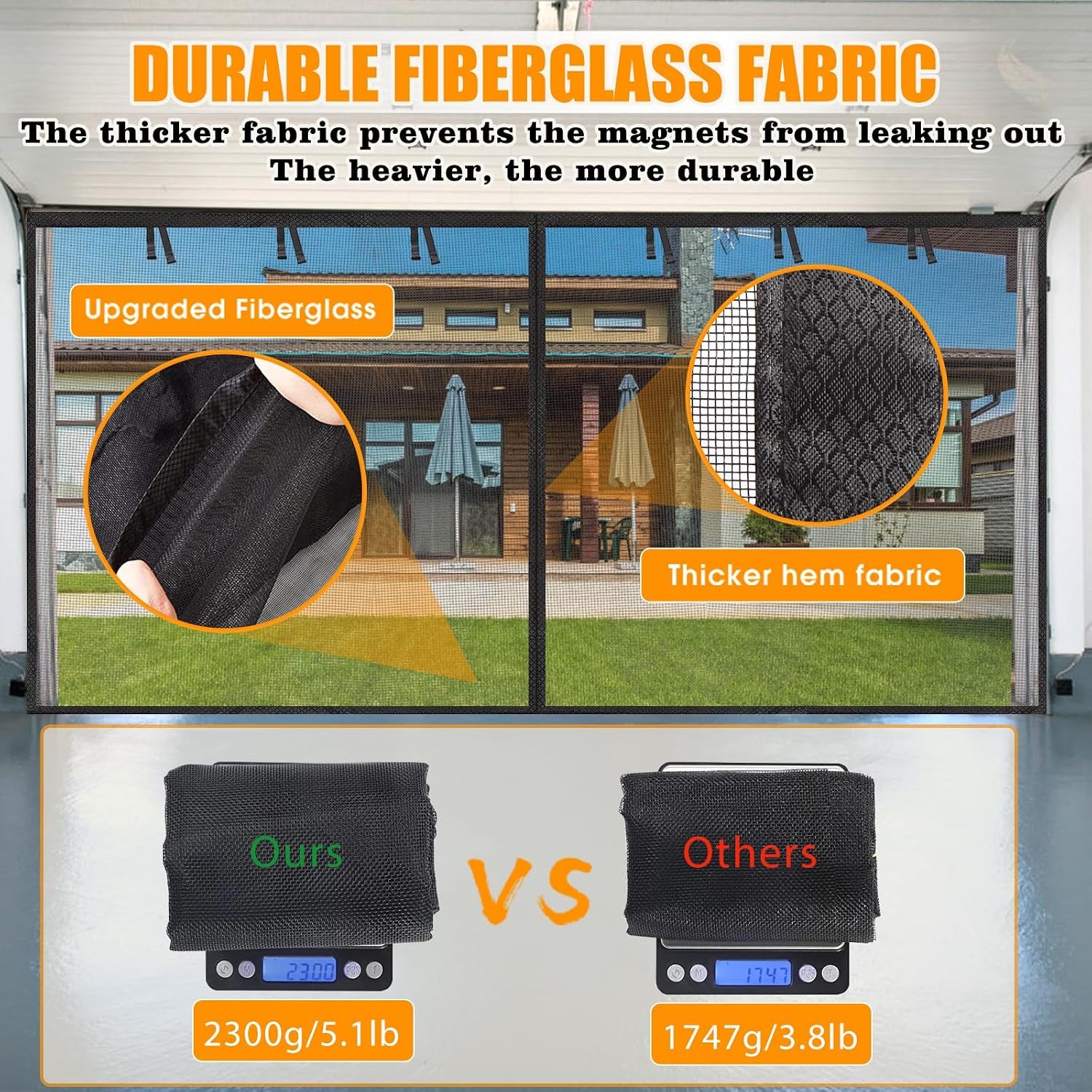
Why fiberglass mesh matters
Mesh screens are usually made from either polyester or fiberglass. Polyester is cheaper and softer. Fiberglass holds its shape better and is harder to tear, which counts in a garage where bike pedals, trolley corners and ladder feet are always catching on things. Fiberglass is also fire resistant, which is a sensible property to have near a workbench, although it is not the same as being fireproof. Keep it away from grinders and welding.
The practical difference you notice day to day is that fiberglass hangs flat. A floppy panel billows, the seam drifts out of line, and you end up tugging at it every time you go through. A panel with a bit of body to it just sits where you put it.
Black is the standard color for a reason. From inside, your eye looks straight past dark mesh and you barely register it. From outside in daylight you see a dark panel rather than into the garage, which gives you some privacy while you work.
Getting the size right
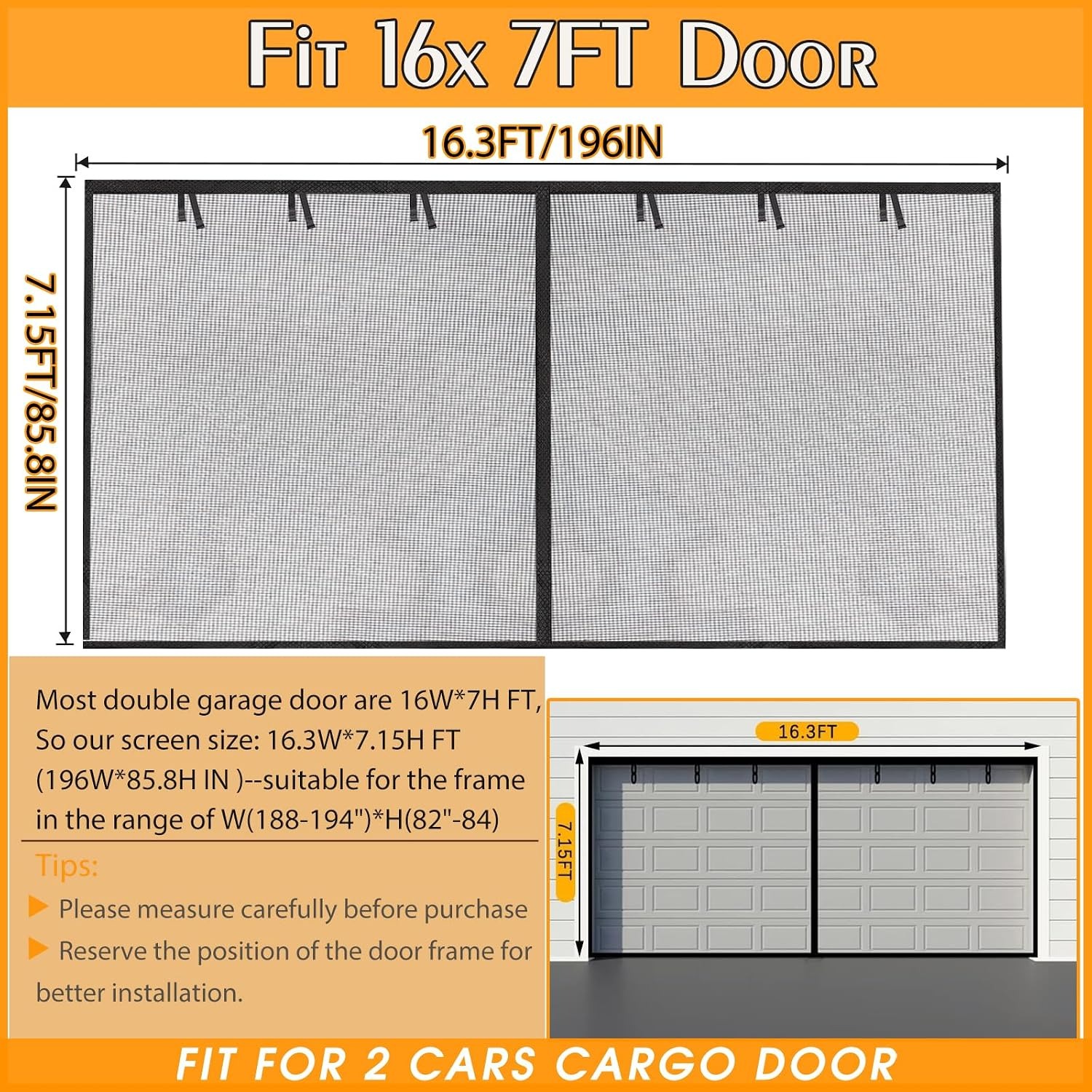
This panel measures 16.3 x 7.15 ft and is designed for a 16 x 7 ft door. In inches, that means openings between 188 and 192 wide and between 82 and 84 high. The extra length and width are not a mistake. You need the spare to wrap onto the frame, which is where the mounting tape goes.
Measure twice and measure the right thing. The opening itself is one number. The frame you plan to stick the tape to is another, and that is the one that matters for how the panel hangs. Measure the width at the top, the middle and the bottom, because older timber frames are rarely square. Measure the height at both edges and in the middle.
If your door is a single, around 8 or 9 ft wide, this panel is the wrong size and gathering the excess will spoil the seal. Look for a single-width screen instead.
Installing it without regrets
The job takes most people under an hour, and most of that is preparation. Two people makes it far easier, because one can hold while the other sticks.
Clean the frame first. Adhesive tape needs a smooth, dry, dust-free surface. Wipe the timber or metal down, let it dry completely, and if the paint is flaking, sort that out before you start. On very rough surfaces, fixing a thin smooth batten and taping to that will give you a much better result than fighting the grain.
Start at the top center and work outwards, pressing firmly as you go. The top strip is carrying the whole panel, so give it attention. Then work down each side. Let the bottom hem find the floor rather than stretching the panel to meet it, and check that the two halves of the seam line up without you holding them.
Then test it. Walk through a few times. If the seam is not closing cleanly, the usual cause is the panel hanging slightly off-level at the top or the gravity sticks not sitting flat.
Living with it
Six roll-up straps are sewn onto the panel. When the car needs to go out, you roll the screen up and tie it clear. It takes seconds once you have done it twice.
One habit matters more than any other. Always roll the screen up before you operate a metal garage door. Magnets and a moving steel panel are a bad combination, and you will spend five minutes untangling a screen that was happily working a moment earlier. Make it part of the routine, the same way you check the mirrors before reversing.
For cleaning, mild soapy water on a soft cloth is all the mesh needs. Rinse it, let it dry fully, and only then roll it up. Never machine wash it, bleach it, iron it or put it in a dryer. A soft broom run over the mesh now and then keeps dust and cobwebs from clogging the weave, which is what kills airflow over time. Keep grit away from the magnets and the hook-and-loop strip, because that is what stops both gripping properly.
If you only use the screen in warm months, roll it, keep it dry and store it flat or loosely coiled somewhere it will not be crushed. Expect to replace the frame-side tape when you put it back up, depending on how it weathered.
Who it actually suits
Anyone running a garage gym is the obvious candidate. Airflow during a session is the difference between finishing a workout and bailing on it, and nobody wants flies landing on them between sets. Home mechanics and woodworkers get the same benefit, with the added point that fumes and dust have somewhere to go.
Families with kids and pets like it for a different reason. The garage becomes a shaded play space on hot days, and children and dogs can go in and out without anyone opening anything. The magnetic seam does that work by itself.
It is also not limited to garages. The same panel will cover a wide patio opening, a shed, a workshop, a veranda or a generous porch. Anywhere with a frame in the right size range and a reason to want air without insects.
The short version
If you have a 16 x 7 ft double garage door, this screen turns an unusable summer space into a usable one. Fiberglass mesh keeps its shape and resists tears. Thirty-six magnets and twenty weighted sticks keep the center seam closed on its own, so your hands stay free. A 4 cm hook-and-loop top strip carries the weight, and six straps roll it clear when the car needs to move.
Measure your opening and your frame before you order, take your time cleaning the surface before you stick anything, and get into the habit of rolling it up before the big door moves. Do those three things and it will quietly do its job for years.